

Tanks & vacuum vessels
Manufacturing in stainless and mild steel with complete assembly, welding and testing — for industry and rail systems across Europe.
Tanks and vacuum vessels in stainless steel
Predire Industries manufactures tanks and vacuum vessels for demanding industrial applications. Our main experience is in stainless steel, where we have delivered to customers including the European rail industry. We handle the entire process — from material procurement and manufacturing to assembly, welding and testing — in our facility in Sölvesborg, Sweden.
Materials and quality requirements
Stainless steel is the dominant material for tanks and vacuum vessels handling aggressive media, high hygiene requirements or corrosive environments. We work with common stainless grades such as SS2333 (AISI 304), SS2343 (AISI 316) and duplex steels when extra strength is needed. For applications where corrosion is not a factor, mild steel can be a cost-effective alternative. We are happy to advise on material selection based on your specific application.
Welding and competence
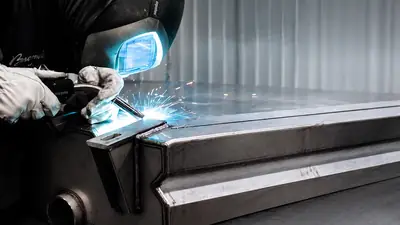
Welding tanks and pressure vessels demands high precision and documented expertise. Our welders have long experience of TIG welding in stainless steel — the welding method that gives the best quality on thin sheet and acid-resistant material. We adapt the welding process to the customer's requirements and applicable standards.
Vacuum vessels and tightness requirements
Vacuum vessels place particular demands on design and manufacturing. The vessel must withstand external pressure without deformation, and every weld must be fully tight. We design vacuum vessels with consideration for buckling risk, the elastic modulus of the material and the actual operating temperature. After manufacturing we perform vacuum testing and leak detection to verify tightness before delivery.
Testing and documentation
Depending on the customer's requirements and application we perform pressure testing, vacuum testing and visual weld inspection. We document test results and can supply material traceability, welding documentation and test certificates. Where required we cooperate with third-party inspectors for independent verification.
Deliveries to European rail industry
A significant share of our experience in tank manufacturing comes from deliveries to the European rail industry. Tanks for rail systems must withstand vibration, resist corrosion and offer a long service life. We have manufactured tanks for sanitation systems and technical installations in rail vehicles, with deliveries to customers in several European countries.
Complete assembly
We offer not only the manufacturing of the tank or vessel itself but also complete assembly with connections, valves, brackets and pipework. By handling the entire assembly process in-house we make sure that all components fit and function as a unit. This reduces the customer's need for in-house final assembly and shortens the total project time.
From single units to series
We handle everything from individual prototypes to short series. Each project starts with a review of drawings and specifications, where we identify any manufacturing challenges and propose optimisations. Our breadth of manufacturing methods — laser cutting, rolling, bending, welding and machining — lets us adapt the production process to your specific needs.
FAQ about tanks and vacuum vessels
We mainly work in stainless steel (SS2333, SS2343, SS2352 and others), but also manufacture in mild steel and carbon steel. The choice of material is driven by the medium's properties, pressure, temperature and any regulatory requirements. We are happy to advise on the right choice for your application.
Stainless steel offers superior corrosion resistance and is essential for aggressive media, food and high hygiene requirements. Mild steel is a cost-effective alternative for applications without corrosion risk, such as compressed air, hydraulic oil or non-corrosive chemicals. The price difference can be significant, so the right material choice saves money without compromising function.
We perform pressure testing, vacuum testing and visual weld inspection depending on the customer's specification. Test pressure and method are adapted to the relevant standard and the intended operating environment. All test results are documented and delivered with the product.
We manufacture tanks and vessels in a range of sizes, from smaller components to larger units. The practical limits are governed by our equipment capacity and transport options. Send us your dimensions and specifications and we will assess what is possible.
Lead time varies with complexity, material and testing requirements. A typical stainless steel tank takes 4-8 weeks from order to delivery. More complex projects with extensive testing may take longer. We always provide a concrete time estimate after reviewing your documentation.
Yes. Send us your drawings or 3D models and we will review them and provide a quote. We can also contribute design proposals if you have a functional description but no detailed drawings yet. Our engineering department works in CATIA V5.
Related services
Contract manufacturing
Laser cutting, turning, milling, press braking, welding and complete assembly in steel, stainless and aluminium.
Read more →Engineering & development
CATIA V5-based engineering in close collaboration with the customer. From concept and prototype to production-ready solution.
Read more →Custom solutions
Truly unique, individual projects built around your specific requirements. Tell us what you need — we will take it from there.
Read more →Request a quote for your project
Send us drawings, specifications or a description of what you need. We will review your documentation and come back with a quote and timeline.